Keep the decision, commitment, and exact source together.
Org2
Build your knowledge locally and put it to work.
Org2 turns your meetings, decisions, notes, and AI sessions into a powerful plain-text workspace that helps you get more done. It's open-source, fully local, and designed to work with the agent, model, or provider you choose—without making any of them the owner of your knowledge.
From decision to done.
Start with a meeting, note, message, or TODO. Org2 keeps the source context attached while the work moves, and interrupts you only when a decision needs you.
Send bounded work to a person or any configured agent, local or remote.
Bring consequential actions and uncertain results back for approval.
Record the outcome and its evidence where the work began.
One place to see what is moving.
Plan your own work, follow delegated work, review decisions, and keep the underlying context intact.
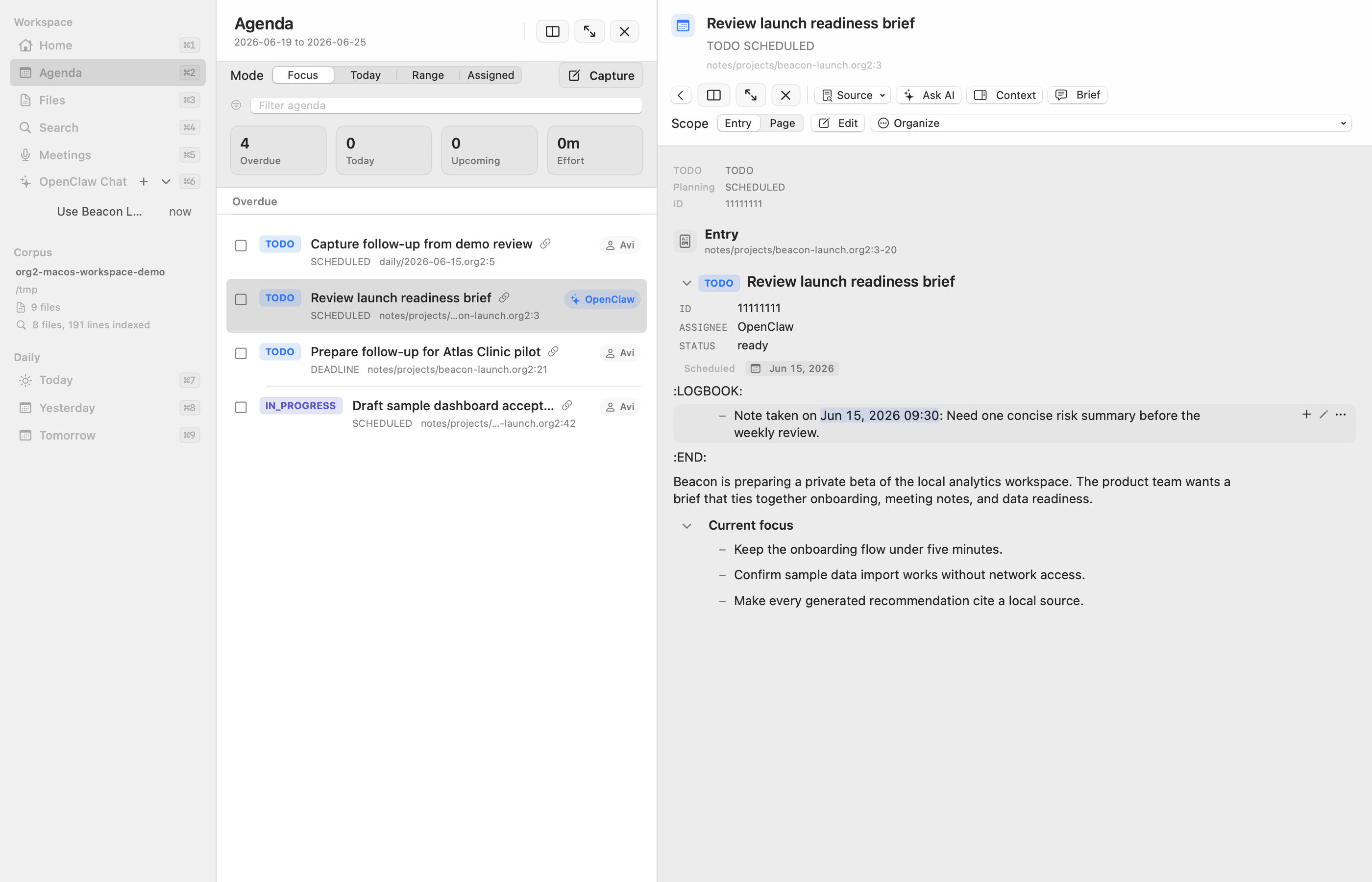
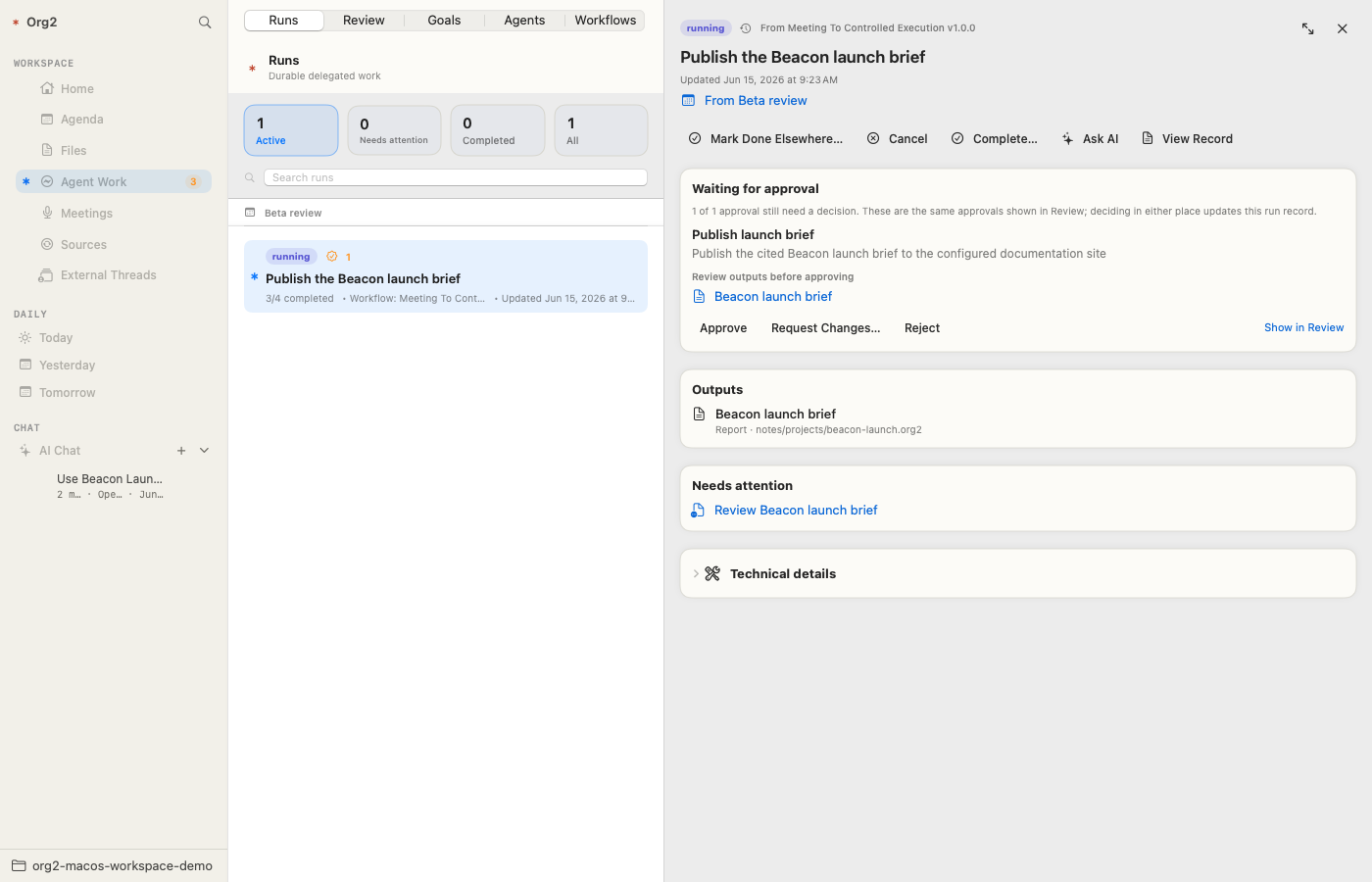
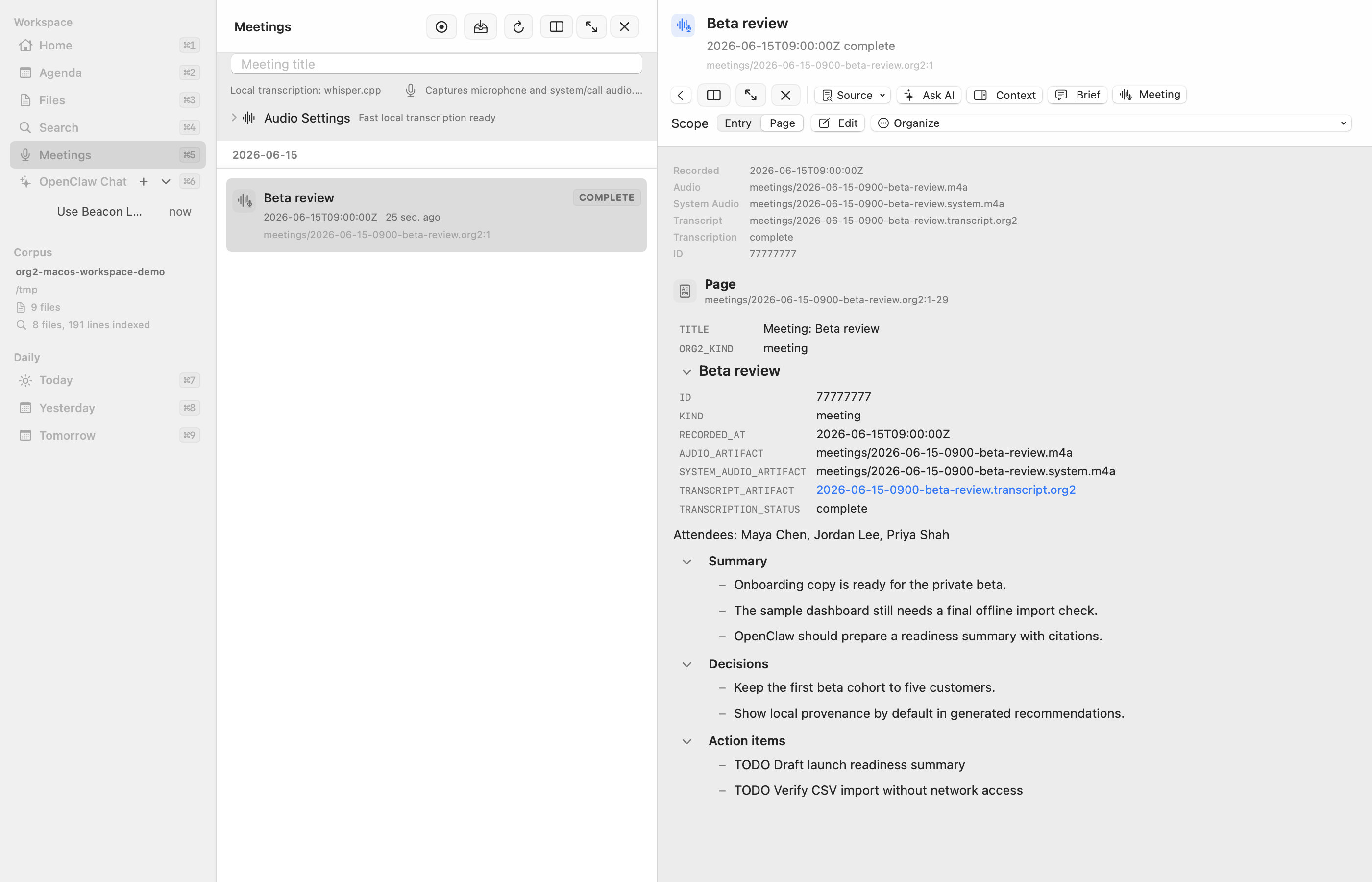
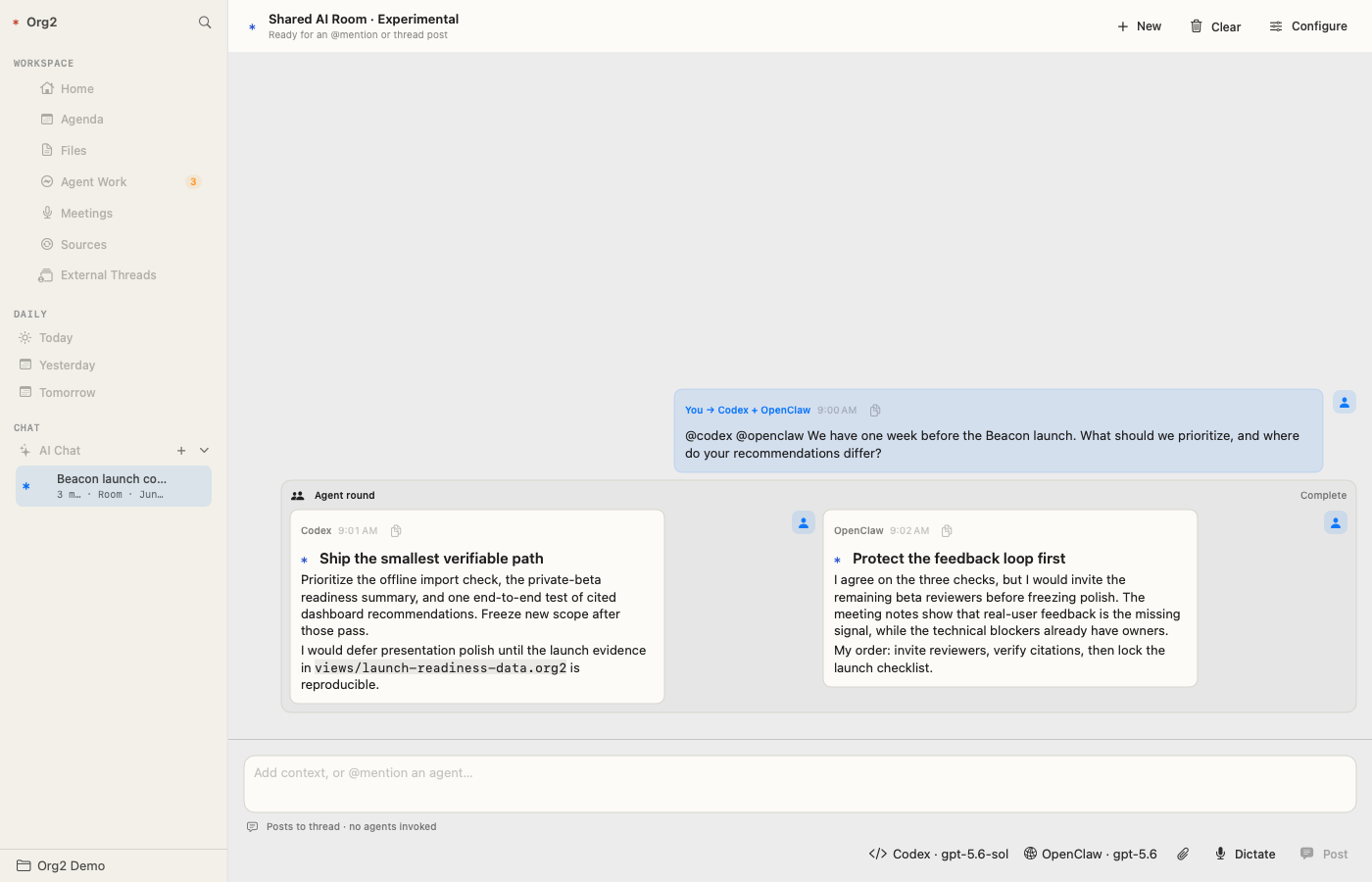
@all—and compare independently attributed answers in one shared thread.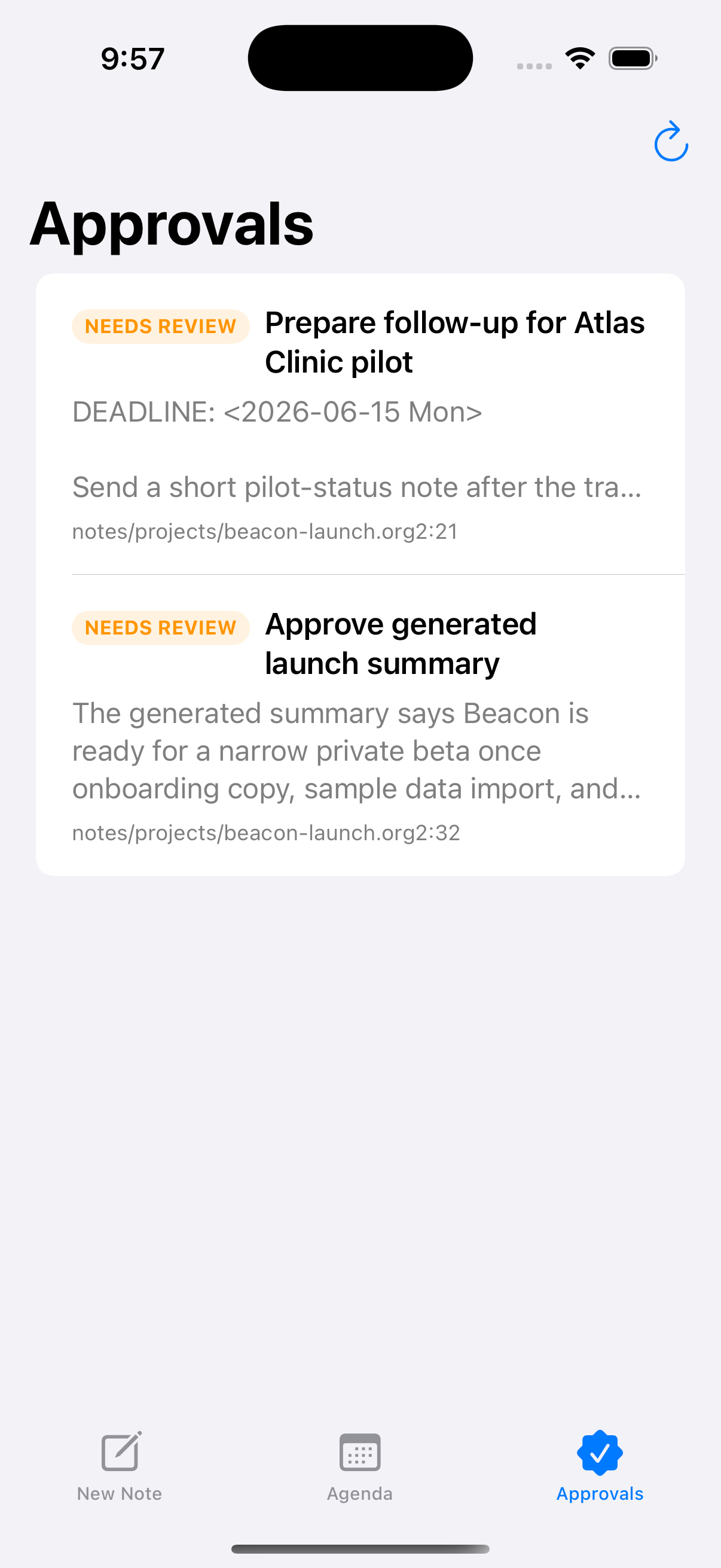
Work ends in something useful.
Org2 keeps finished artifacts connected to the decisions, data, and source material that produced them—not stranded in a chat transcript.
Talks and slides
Develop a talk beside its research, preview it as slides, and export a presentation-ready PDF.
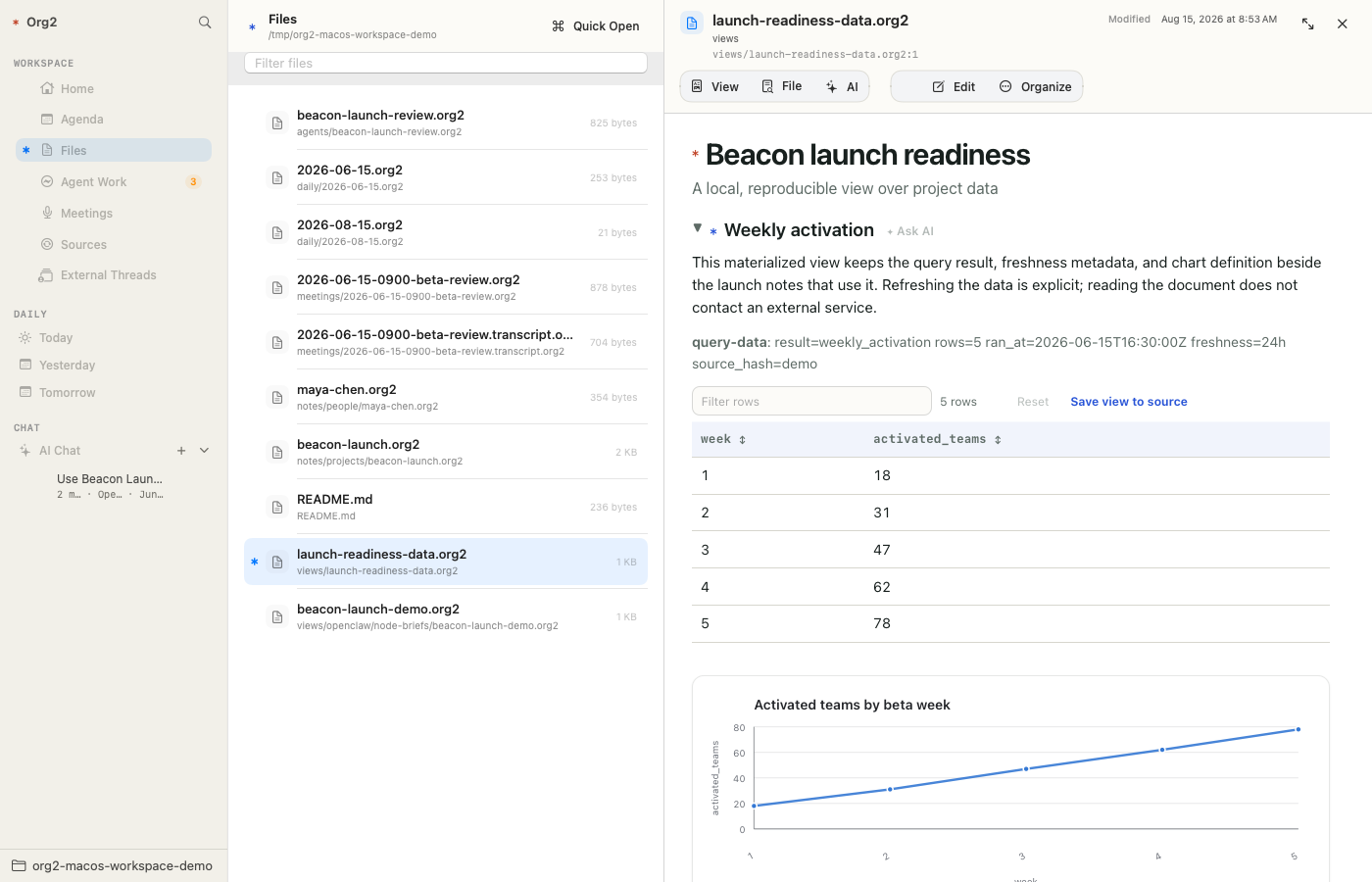
Analytics and visualizations
Query data, materialize reviewable results, and publish tables and charts with freshness and provenance intact.
Customer-ready PDFs
Turn approved source material into quotes, reports, and marketing collateral without losing the evidence behind it.
What an Org2 file looks like
One plain-text document can carry notes, tasks, dates, links, data records, source provenance, and agent handoff boundaries while staying readable in any editor.
#+title: Product launch workspace
#+filetags: :launch:q3:
#+roam_aliases: beta launch rollout

* TODO Ship beta checklist :product:
  SCHEDULED: <2026-06-01 Mon>
  DEADLINE:  <2026-06-12 Fri>
  :PROPERTIES:
  :ID: launch-beta-checklist
  :EFFORT: 3h
  :OWNER: Product
  :END:

  - [X] Draft invite copy
  - [ ] Confirm onboarding path with [[id:design-review][design review]]
  - [ ] Publish release notes from [[file:release-notes.org2][release notes]]

** Meeting notes
  Decisions:
  - Keep beta small until support docs are complete.
  - Track follow-ups in the same file as the project plan.

** Source query for docs
  ``` sh
  org2 query --tag launch --format json
  ```

** Launch readiness data :evidence:
  :PROPERTIES:
  :ID: launch-readiness-data
  :KIND: dataset
  :END:

  ```dataset launch_readiness
  type: csv
  path: data/launch-readiness.csv
  engine: duckdb
  ```

  ```sql results=launch_readiness_summary artifact=views/launch-readiness.org freshness=24h
  SELECT week, activated_users, blocker_count
  FROM launch_readiness
  ORDER BY week DESC
  ```

** TODO Summarize launch blockers
  :PROPERTIES:
  :ID: launch-blocker-summary
  :ASSIGNEE: research-agent
  :STATUS: ready
  :CONTEXT: id:launch-beta-checklist, id:launch-readiness-data
  :END:

  Summarize launch blockers with citations.

* AI draft summary :draft:
  :PROPERTIES:
  :ORG2_ARTIFACT_ROLE: view
  :ORG2_PROVENANCE: file:raw/calls/beta-kickoff.org2, id:launch-readiness-data
  :ORG2_CLAIM_STATE: source-backed
  :ORG2_REVIEW_STATUS: review-required
  :END:

  The beta should emphasize local files, agenda workflows,
and source-backed AI summaries.A durable follow-through system
Most second brains help you find what you knew. Org2 also tracks what you decided, who or what is acting on it, which decisions still need you, and what evidence proves the work finished.
Your files remain the source of truth. Apps and agents share the context, people keep clear review boundaries, and changing a model, agent, or client does not mean starting over.
What you can do with it
Turn commitments into follow-through without separating them from the conversation or document that created them.
Delegate across people and agents while keeping responsibility, progress, and context visible.
Review the decisions that matter in one approval queue instead of watching every agent step.
Produce useful artifacts including talks, analytics, visualizations, reports, PDFs, and published sites.
Keep durable memory that people can read, agents can cite, and no single model or application owns.
Private-by-default agent collaboration
A useful agent workspace needs precise sharing boundaries. Org2 keeps files local by default and can encrypt individual subtrees to you, a device, or a specific agent key. Encrypted notes remain ordinary files that can sync through Git, iCloud, Syncthing, or any transport you choose.
How it works
Org2 reads ordinary .org and .org2 files and compiles their tasks, links, dates, properties, provenance, and agent boundaries into one shared semantic model. Native apps, editors, CLI and MCP clients, runtime adapters, and configured models all work from that same source-backed context.
The result is deliberately boring composability: inspectable files that can drive daily planning, agent workflows, data views, and publishing without locking the work into one application.
Start here
Org2 is early alpha, but already practical for CLI, VS Code, and native Mac workflows.
Reference post: Standalone Org rationale